If you visit LA by Sept. 14, 2014, you may want to see the Expressionism Exhibit at LACMA. Wear your crash helmet, as narrow lanes, fast cars, and death-wishers made this more of an adventure than I wanted.
Forgive the poet in me, but LA air looked like a giant dragon fart. On the way, it was sad driving over Ballona Creek to look down and see cement. In a related matter, I read at the L. A. Story Virtual Tour, "1910 Last salmon seen in Los Angeles River." For all of the leaders here who should have protected their ecosystem, words of Pink Floyd come to mind: "Did you exchange a walk on part in the war for a lead role in a cage?" In other words, LA people are breathing dragon fart so oil company owners can have collectively over 250 trillion dollars if you can wrap your mind around that fact. At the same time, Mega-food companies are feeding people garbage that makes them sick. Watch this 2 minute trailer from Forks Over Knives which really could save your life if you haven't seen it -- but maybe your life isn't worth 2 minutes to you, I don't know.
Most of these economically and politically-powerful men have consciences so even if there were no God or universal life energy, they still lose the argument. Kabir wrote, "people won't wake up -- Not until they feel death's club inside their skulls." Each year I teach I have a theme. This year it is "Try to wake up."
Wednesday, August 20, 2014

Saturday, August 9, 2014
Enlightenment for $19.99
Thanks to Festival Writer for publishing my new poem "Enlightenment for $19.99" about Jungian psychology, real and imaginary Post Office clerks, and a "genuine whale tooth" I never received from BAZOOKA Bubble Gum at Box 9200, St. Paul, MINN 55177. Hey, AWP is in Minnesota this year! Maybe I could stop by and get it. Actually, we should all let whales keep their teeth.
Festival Writer appears at AWP, SSML, and M/MLA, and "Premier[ed] in 2009 as an offsite event at AWP." Its regular issues publish five to seven authors, and special issues more. Poets there you may recognize include Shaindel Beers, Susan Yount, and Valentina Cano.
Thursday, August 7, 2014
The Healing Power of Water
 | |||
| A fat 14-inch trout fresh from the sea. |
 |
| Also Known As Heaven Creek |
 |
| There is almost nothing electrician's tape and Maxima leader can't fix. See this creekside eyeglass repair. Notice the fine craftsmanship and precision work. Maybe when I retire I will open a fishing tackle/eyeglass repair shop. |
 |
| Andy Goldsworthy's film Rivers and Tides inspired this Howling Banshee. Maybe thousands of lifetimes ago, he started this way. |
 |
| Turkey Vulture Serenade |
 |
| That's what I'm talking about! |
This summer I did Blame and Denial Therapy. I am getting good at blaming others for my troubles, even strangers who have nothing to do with what happened. Denial Therapy is harder since it goes against my nature as a poet, but I have been watching how Western Civilization does it.
One of my students, mimicking Bart Simpson, said, "I didn't do it. Nobody saw me do it. You can't prove anything."
"Son," I replied, "you are destined for the U. S. Congress."
Unhatched Caddis
struggling in the raft bag
in the back of my car
required an 8 hour drive
back to her native river.
I was accused of doing it
on purpose
so I could go fishing
but it was because
I too had been taken
from my home
of ancient evergreens
and swift pure waters.
For years I have watched them
hatch and rise
like tiny wish-granting fairies
landing on my arm.
On our long drive
she sat by me in a blueberry
Nancy's yogurt cup
and I kept the music low
so as not to hurt
her caddis ears
which had maybe
already been injured
when my landlord said,
"Does Scott know
the carbon footprint
to save that bug?"
At the river
caddis crawled away
in her stone tower
and lived happily ever after,
maybe the only one
of her kind
in 10,000 years
to be that crazy-lucky.
Sunday, August 3, 2014
The Fish Who Swallowed Time
Thanks to The Release Literary Magazine for publishing my poem "The Fish Who Swallowed Time" in their inaugural issue.
I know gravity only works
because of the curvature
of space-time, while
constellations burst and fade
like embers of far away cigarettes
on the Deschutes River.
There was a frog watching a
dragonfly until it lunged
and Mr. Dragonfly was no more.
The moment I hooked the steelhead,
I forgot about everything else.
The Fish Who Swallowed Time
because of the curvature
of space-time, while
constellations burst and fade
like embers of far away cigarettes
on the Deschutes River.
There was a frog watching a
dragonfly until it lunged
and Mr. Dragonfly was no more.
The moment I hooked the steelhead,
I forgot about everything else.
Wednesday, July 30, 2014
Salmon Thoughts
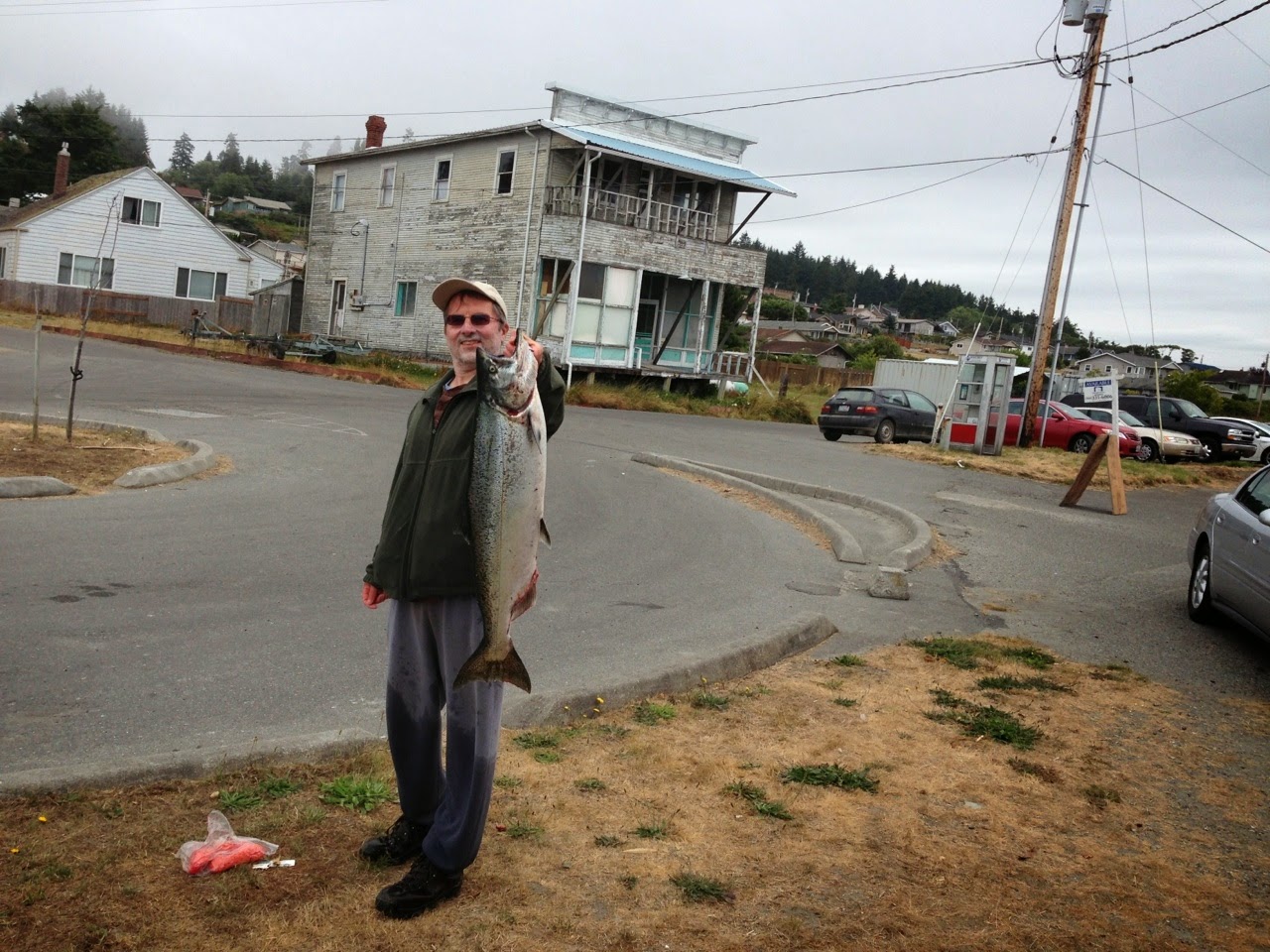 |
| Thanks to Bonnie for taking this photo and emailing it. |
At a recent party, I had to disagree with an old guy who half-quoted Shakespeare, "Life is a meaningless tale told by a fish, full of spinners and bait, signifying nothing." -- obviously not a fisherman. He continued by half-quoting The Kinks, "Just like cherry-cola, Y-O-D-A, Yoda." I could only respond, Yoda said "There is no try [to go fishing]. Do [ . . .]."
Monday, July 21, 2014
Raft and Spinner
 | ||||||
| Two coastal summer steelhead I caught four days ago. |
 |
| Surf perch add variety to your fishing. |
 |
| On my way home to Whidbey, an inland river a few days ago produced two more steelhead. |
For 30 years, my lure of choice in low water has been a 3/8 ounce Panther Martin with gold blade, and black yellow-dotted body. Snip off two of the hooks so your single hook won't injure trout and smolts the way a treble does.
Here is my checklist:
> fish license and gear
> boat license if needed
> needle nose pliers (leave wild fish in water, and wet hands before you touch any fish)
> file to sharpen hooks dulled by snags
> water and food
> sun hat
> oars
> extra oarlocks
> fish bag with ice
> arrange shuttle or use bike
> bug repellent
> sunscreen
> TP in ziplock bag (carry this out)
> sunglasses
> anchor and rope
> life vest
> shoes with felt and steel nubs to prevent falls
> raft patch kit
> bring fishing buddy or leave note about your plans
> pen and notebook to write poems
> backup fishing rod and reel
> backup glasses
> large sponge to bail water
>smile
Here are two poems I wrote on my last float:
July Moon
Maybe death is like the day
I floated a coastal river
so tranced by summer steelhead,
periwinkle cities, and wildflower scents,
I missed the boat ramp,
and miles below discovered
I didn't care
but kept fishing
under the warm July moon.
Riverspeak
After two days without speaking,
the river speaks below my raft,
and steelhead whisper
how they are going to
whack the hell
out of my spinner.
Each day of my life
the river flowed
in this canyon beneath sentinel spruce.
I had a real choice
to be here or not,
and much too often
I chose wrong.
Tuesday, July 8, 2014
2014 FOR Seabeck Conference on Hood Canal in Washington
I spent July 3 through July 6 as a Friends of William Stafford Scholar at the "Speak Truth to Power" FOR (Fellowship of Reconciliation) Seabeck Conference on Hood Canal in Washington. I wanted to go because poet William Stafford and his wife Dorothy were FOR members since the 1940s.
A favorite part of the conference for me was a song Iceland, 2008, by David Rovics. Regarding background of the song, March 6, 2010, Sarah Lyall of the New York Times reported "With all but 2,500 of the 143,784 votes counted, the authorities said, 93 percent voted 'no' [on the Icesave "Repayment Plan"] and 1.8 percent voted 'yes' in the first public referendum ever held on any subject in Iceland. [ . . . .] The vote shows the depth of Icelanders’ rage. They are angry at the British and Dutch, who they say are mistreating them; angry at the regulators and government officials who failed to properly oversee the Icelandic financial system; and angry at the bankers whose recklessness helped the economy grow at a headspinning rate and then caused it to self-destruct in days." The news story quoted Icelandic President Olafur Ragnar Grimsson who reportedly said on Bloomberg Television, "Ordinary people, farmers and fishermen, taxpayers, doctors, nurses, teachers, are being asked to shoulder through their taxes a burden that was created by irresponsible greedy bankers." Sound familiar?
The bravery of Icelandic people who refused to be cowed by many threats caused significant challenges for the global banking system. Fearing a run on European banks, it was reported the United Kingdom and the Netherlands compensated their Icesave customers. A news story in The Guardian by Simon Bowers amended January 29, 2013, noted " UK taxpayers are expected to recoup all of the £4.3bn owed, though the recoveries will come from priority claims against the estate of Landsbanki [instead of from Icelandic fishermen and other citizens]."
If you are looking for a community of truth-seekers and activists with vast awareness of history, social justice and ecological issues on a global scale, peace-strategies and healthy nonviolent ways to respond, you may want to consider FOR. At the 2014 Conference near Hood Canal, I heard wonderful presentations from Steve Richmond of Garden Cycles on native plantings and invasive weed removal; Dr. Michael Nagler, winner of a 2002 American Book Award, on the power of nonviolence; Dr. Peter Phillps, former Director of Project Censored , which reports the top 25 censored stories each year; and Tim Barnes, Ilka Kuznik, and Joanie McClellan on William Stafford's poems and experience as a conscientious objector during WWII. I helped out with two sessions called "Peace of Art" which combined Stafford's poetry with collages from nature scenes, historical events, and villains or activists. I enjoyed breakfast one morning with the social justice activist/muralist Roberto Oran whose work was inspired by great Mexican muralists like Rivera, Siquieros, and Orozco.
Watch for the next FOR Seabeck Conference near July 4, 2015.
A favorite part of the conference for me was a song Iceland, 2008, by David Rovics. Regarding background of the song, March 6, 2010, Sarah Lyall of the New York Times reported "With all but 2,500 of the 143,784 votes counted, the authorities said, 93 percent voted 'no' [on the Icesave "Repayment Plan"] and 1.8 percent voted 'yes' in the first public referendum ever held on any subject in Iceland. [ . . . .] The vote shows the depth of Icelanders’ rage. They are angry at the British and Dutch, who they say are mistreating them; angry at the regulators and government officials who failed to properly oversee the Icelandic financial system; and angry at the bankers whose recklessness helped the economy grow at a headspinning rate and then caused it to self-destruct in days." The news story quoted Icelandic President Olafur Ragnar Grimsson who reportedly said on Bloomberg Television, "Ordinary people, farmers and fishermen, taxpayers, doctors, nurses, teachers, are being asked to shoulder through their taxes a burden that was created by irresponsible greedy bankers." Sound familiar?
The bravery of Icelandic people who refused to be cowed by many threats caused significant challenges for the global banking system. Fearing a run on European banks, it was reported the United Kingdom and the Netherlands compensated their Icesave customers. A news story in The Guardian by Simon Bowers amended January 29, 2013, noted " UK taxpayers are expected to recoup all of the £4.3bn owed, though the recoveries will come from priority claims against the estate of Landsbanki [instead of from Icelandic fishermen and other citizens]."
If you are looking for a community of truth-seekers and activists with vast awareness of history, social justice and ecological issues on a global scale, peace-strategies and healthy nonviolent ways to respond, you may want to consider FOR. At the 2014 Conference near Hood Canal, I heard wonderful presentations from Steve Richmond of Garden Cycles on native plantings and invasive weed removal; Dr. Michael Nagler, winner of a 2002 American Book Award, on the power of nonviolence; Dr. Peter Phillps, former Director of Project Censored , which reports the top 25 censored stories each year; and Tim Barnes, Ilka Kuznik, and Joanie McClellan on William Stafford's poems and experience as a conscientious objector during WWII. I helped out with two sessions called "Peace of Art" which combined Stafford's poetry with collages from nature scenes, historical events, and villains or activists. I enjoyed breakfast one morning with the social justice activist/muralist Roberto Oran whose work was inspired by great Mexican muralists like Rivera, Siquieros, and Orozco.
Watch for the next FOR Seabeck Conference near July 4, 2015.
Tuesday, June 24, 2014
Summer Steelhead and Tiger Lily
 |
| 10 pound Summer Steelhead |
 |
|
Tiger Lily or Lilium Columbianum named after
the mighty Columbia River
|
Monday, June 9, 2014
Salmon vs Shad
 |
| Spring Chinook I caught yesterday. |
 |
| "Columbia River Tarpon" also known as shad. These guys are fun to catch in the afternoon. They are used for halibut bait and crab bait, and some brave souls can them with garlic or jalapeno, or pickle them. OPB has a story in which the writer noted "My family prefers shad to salmon." I'm glad the writer's family likes shad, but I'll take the salmon every time. |
My fishing buddy Slim told me a story about his friend who was late to his own wedding due to fishing so I guess there may be a few souls even more serious about fishing than I am.
Friday, June 6, 2014
I know Rumi wrote, "The wound is the place where the Light enters you." but sometimes it's just a fishhook.
 |
| [Sperm Whale] by Archibald Thorburn, 1860–1935 | Public domain in United States, via Wikimedia Commons |
Monday, June 2, 2014
Fishing Essay and New Poem
Many
thanks to the powerful Alaskan writer Marybeth Holleman for reposting
my fishing essay from August 2013 along with a new poem from
yesterday, June 1, 2014, called "Water Cave Near Mogollon Rim" about a
place I visited in Arizona.


Friday, May 30, 2014
Blonde Mermaid Caught by Orcas Island

Monday, May 19, 2014
Eight of My Clay Pieces, Good for the Next Two Ice Ages, and Last Week's Melting Antarctic Glacier News

November

The Dream of Seven Tails (featured at The Trumpeter Journal of Ecosophy at Athabasca University in Alberta, Canada, and donated to Columbia Basin Fish & Wildlife Library,
a program of the Columbia River Inter-Tribal Fish Commission)

October Chinook (sold at the The Spirit of the Salmon Fund's Wy-Kan-Ush-Pum "Salmon People"Gala in Portland, Oregon)

Steelhead Harp (donated to Washington State University, Vancouver Library)

Life Force (donated to Washington State University, Vancouver Library)

River Fire (sold at the The Spirit of the Salmon Fund's Wy-Kan-Ush-Pum "Salmon People"Gala in Portland, Oregon)

October River (donated to Columbia Basin Fish & Wildlife Library,
a program of the Columbia River Inter-Tribal Fish Commission)

Return to the Source
(sold at Columbia River Gallery in Troutdale, Oregon)
What Happens Next
Because of monetary belief, a few humans will soon decide the fate of Earth’s people, sea creatures, animals, forests, meadows, mountains, reefs, and islands.
According to Laura Barron-Lopez of thehill.com, Bill Gates hopes new technology will save us.
According to Bill Gates’ interview in Rolling Stone, Charles Koch says the problem is bigger than the USA can solve.
According to the WSJ, Warren Buffett is a “climate-change denier.”
When these billionaires discuss climate change at "dinner," you know there is a problem.
On May 13, 2014, Jason Hanna, of CNN, reported “The United Nations' most recent climate change report estimated sea levels could rise from about 1 foot to 3 feet by 2100. Such a rise could displace tens of millions of people from coastal areas around the world.”
Isaac Asimov responded in a Dissolving Boundaries film interview to Bill Moyers’ question about a global perspective, “It’s perhaps not important that every human being think so. But how about the leaders and opinion-makers thinking so? Ordinary people might follow them.”
In the film I Am, the Dalai Lama said the most important meditation of our time is critical thinking followed by action.
Black Elk said in Black Elk Speaks (translated from Lakota into English by Black Elk's son, Ben Black Elk, and written by John G. Neihardt), “Crazy Horse dreamed and went into the world where there is nothing but the spirits of all things. That is the real world that is behind this one, and everything we see here is something like a shadow from that one. He was on his horse in that world, and the horse and himself on it and the trees and the grass and the stones and everything were made of spirit, and nothing was hard, and everything seemed to float. His horse was standing still there, and yet it danced around like a horse made only of shadow, and that is how he got his name, which does not mean that his horse was crazy or wild, but that in his vision it danced around in that queer way. It was this vision that gave him his great power, for when he went into a fight, he had only to think of that world to be in it again, so that he could go through anything and not be hurt.”
Monday, May 12, 2014
Monday, April 28, 2014
Practicing "the Speech"
One of the best spring salmon fishermen on a river I visit gave me "the speech" to get out of trouble with a girlfriend. "I am sorry. It was my mistake. Please forgive me." He had been a missionary on many continents so I figured it was worth a try.
The next time she and I had an argument, I tried but forgot a few words. "I'm sorry. It was your mistake. I forgive you."
When I saw him on the river, I explained I messed up a few words so his "speech" didn't work.
"What exactly did you say?" he asked.
When I told him, he said I needed more practice.
Saturday, April 26, 2014
Seattle's Monarch Review Published My Eco-Poem "Thinking About AWP 2014 in Seattle"
"Thinking About AWP 2014 in Seattle" (click if interested in a poet's perspective)
Monday, April 21, 2014
Fisher-in-Residence on Cascade Head
 | |||
| Some of the poems were written at The Sitka Center for Art and Ecology in Oregon. |
Anyway, since I had some positive responses on my last post, I decided to expand it. Years ago, I applied to be a writer-in-residence at The Sitka Center for Art and Ecology on Cascade Head partly because I wanted to catch winter steelhead close by. In case you haven't figured it out, most of my major life decisions are made based on proximity to salmon and steelhead fishing.
For eight years on The Starfisher, I trolled and drifted reefs off Cascade Head, and explored rivers north and south on my days off. I was so excited when my application was accepted, I oiled my reels.
When I arrived in January 2004, the weather did not entirely cooperate. A rare ice storm threatened my plans. At the time, I was reading Early Morning by Kim Stafford. The guest book in my Russ' Treehouse studio had entries by Kim, and this gave my adventure a meant-to-be feel. Without hesitation, I put tire chains on to discover I was the only driver foolish enough to be on the road. Later, Oregon.gov noted "President Bush issued a major disaster declaration for 26 Oregon counties affected by the winter storm." I spent a large part of the morning weaving around, or physically removing, fallen alders on the way to my chosen river.
My car radio said schools were closed and issued a warning to "stay off the roads." Like a wounded muskrat, I slowly maneuvered until I made it. "Where in hell did you come from?” a local who had walked down to the river greeted me. “It’s 28 degrees,” he added.
I just smiled and unpacked my gear, thinking of warmer days when Chinese poet Li Po wrote his famous poems about this.
On the still-dark trail there was windless silence but ice-weighted branches fell like spears. The water, however, flowed perfect steelhead green. I was dizzy with cold but determined.
Four hours later I had a fish on who threw the pink-cured prawn and orange Corky. Suddenly, it felt a little warmer. Two minutes after that, I had a really big steelhead on – maybe sixteen pounds -- who broke the line two feet from shore because the cold made me clumsy (fishing buddies would say it had nothing to do with the cold).
Only minutes later I hooked a third steelhead who saw a huge branch floating through the far side of the hole and made for it like a wide receiver going for the end zone. Downriver went the branch and steelhead.
My right brain and left brain, perhaps short-circuited by the cold, engaged in a quick argument. Right – “We can do this. Let’s scramble along that undercut bank and across those boulders. See the river bottom over there? The water can’t be more than five feet, even with the reflection, and you are six feet, more if you get on your toes. Besides, we can cross farther down . . . What’s that? Sure the water is fast there, but it’s shallower too. How bad do you want this fish? Chicken.” Left – “Need I remind you the air is 28 degrees? Can you spell h-y-p-o-t-h-e-r-m-i-a? No fish is worth getting wet. Live to fish another day. You can’t be stupid enough to drive, and crazy enough to leap into a winter river, can you?”
Right, as usual, won, and into the river I went. Water poured over the top of my hip waders as the steelhead leapt in his cage of branches above the tailout. I sprinted downriver to shallower faster water, rod tip high in the air, numb as an Alaskan cadaver in December, and 70 yards later, landed the fish and branch above rapids.
I could go on but was told blog posts need to be short. Suffice it to know the branch was a 40-pound alder, a little smaller than the ones I removed from the road on Cascade Head, but entirely capable of putting up a good fight when attached to a winter steelhead in a swift tailout. I shared my steelhead and story with a painter-in-residence.
Years later, I took a wonderful workshop from Drew Myron at The Sitka Center, and had my all-time favorite reading experience at her Off the Page event in Yachats.
Friday, April 18, 2014
Fish or Cut Bait or Teach
 |
| Photo by John Campbell. Click photo to see text. |
A year ago, and seven years ago, I did sabbatical work at Pacific University's Residency-only M. F. A. Program in Seaside, Oregon, partly to catch winter steelhead. I caught the two above at sunrise just before my creative nonfiction workshop taught by the smart and humorous Craig Lesley, author of the novel The Sky Fisherman. The photo above ended up in Pacific's M. F. A. brochure I found wandering the tables at AWP 2014 in Seattle, oddly thinking maybe I should be fishing for late-run winter steelhead.
The idea of combining fishing with my job may have come when I read how Jack Hemmingway, author of Misadventures of a Fly Fisherman and son of Noble Prize-winner Ernest, "managed to smuggle his fly rod along on his [WWII] French mission and was almost captured while trout fishing" according to New York Times writer Paul Schullery.
Then again, maybe the idea came when I was a deckhand off Depoe Bay, Oregon, saw a wedding party offshore on the mighty Tradewinds Kingfisher, and wondered aloud, "Man, there is a truly great tiderip moving toward them. It's probably full of salmon. What's wrong with dropping a baited hoochie and flasher into the sea? The poles are right there."
It's nearly killing me now to be in San Diego during spring chinook season, but, unfortunately, tenured professorships in creative writing in Oregon are nearly as rare as barcodes on wild chinook. Maybe if I spent more time writing, and less time fishing, some day in the distant future I may have a chance. Nah.
Monday, April 7, 2014
Spring Chinook in April 2014


"After Moonless Midnight." Here are two lines:
"Their eyes waited, furious with gold brightness,"
"Their savagery waited, and their explosion."

The infamous skunk cabbage is a harbinger of spring on the
Pacific Northwest coast.

Spring chinook season is my favorite. I wait all year for the tug of a monster silver slab from the deep, followed by delicious red flesh with basil, olive oil, and lemon pepper. A few days ago I was lucky enough to land two on spinners, which I quickly clubbed, along with three bonus wild steelhead I quickly released. While I love teaching creative writing and world literature in San Diego, I'm envious of Pacific Northwesterners who get to fish every day this time of year. Their stories, generosity, and laughter show evidence of lives well-lived.
Warm sunny days mixed with rain and gray clouds make this a time of transition. Winter's mold and moldy thoughts vanish with the cry of "Fish on!"
I mentioned Ted Hughes' writing about fishing in my first blog post called "Metabolism of Stars," and again above, because Pacific Northwest spring is about circles and renewals. In my first blog post, Senegalese environmentalist Baba Dioum was quoted, "In the end, we will conserve only what we love, we will love only what we understand, and we will understand only what we are taught." It reminds me of a poem by Thomas Rain Crowe in his book Zoro's Field titled "May It Continue." I use Zoro's Field in my creative nonfiction classes, and many students love it.
Regarding the eco-theme, thanks to poet Miriam Sagan for interviewing me on her blog, Miriam's Well: Poetry, Land Art, and Beyond with these three questions: "1. What is your personal/aesthetic relationship to the poetic line? That is, how do you understand it, use it, etc.; 2. Do you find a relationship between words and writing and the human body? Or between your writing and your body?; and 3. Is there anything you dislike about being a poet?" Thanks also to Beverly Faxon at Skagit Valley Food Co-op where I shop for her brief review of my book The Other History, and for placing that review beside an article on "The Hidden Secrets of Chocolate." Life is good, for now, and I hope to catch more springers in late May when I return from teaching.
Tuesday, March 4, 2014
The Godfather Box and the Net of Indra
I know there is some kind of synchronicity in the universe. The Hindu concept of the Net of Indra was right about that. Not far from The Raven Chronicles J29 table I staffed at the AWP Bookfair in Seattle was The Converse College Low-Residency MFA table which runs South 85 Literary Journal, publisher of my eco-poetry post "The Godfather Box" the week before.
Probably the best AWP 2014 panel I attended was Rounding the Human Corners: Writing the Truth about the Changing World. (Marybeth Holleman, Linda Hogan, Ann Fisher-Wirth, Eva Saulitis, Juan Carlos Galeano). In that panel, Linda Hogan spoke about migratory birds no longer showing up in the far north where the Gwich'in people live, and how some of our vets are trained to be business people instead of healers. Eva Saulitis spoke about a group of orcas called the Chugach Transients going extinct due to mortality and reduced reproductive capacity which may have resulted from the Exxon Valdez Oil Spill in Prince William Sound. Marybeth Holleman spoke about the "first-ever recorded" helicopter observations of four drowned adult polar bears due to global warming, and how a yearling wolf in Denali helped wolf cubs on a dangerous river crossing thereby showing these wolves function in the wild as families (I noticed there is a Hafiz quote on her site so there is another Net of Indra moment if you read my post "January in Oregon" below.) AnnFisher-Wirth read amazing poems about the Mississippi Delta area. Juan Carlos Galeano explained, through poetry, how to use one's imagination to enter the ancient mystery of the predator/prey relationship in Amazonia and elsewhere. The whole event was wise, informative, and facinating. In more enlightened times such as those experienced by the the Hau de no sau nee (ho dee noe sho nee) of the Six Nations, also known as the Iroquois Confederacy, these speakers would have greater say in how things are run in the U. S. Congress instead of the oil companies that commonly puppet our elected officials.
On a personal note, Marybeth Holleman's wolf part brought memories of waking up in the middle of a caribou herd just before crossing nontechnical Anderson Pass in Denali.
Other fine panels I attended included The Literary Legacy of Nirvana and Kurt Cobain, True North: Alaskan Literary Nonfiction, A Tribute to the Poetry of Raymond Carver, and The Greening of Literature: Eco-Fiction and Poetry to Enlighten and Inspire (in which Ann Pancake spoke of her novel Strange As This Weather Has Been about mountaintop mining in Appalachia).
At Kells, my colleague Bonnie ZoBell read from her new book What Happened Here. I enjoyed visiting with Alaskan fiddling poet Ken Waldman again.
Tanya Chernov visited my table with postcards to help promote her new anthology Burden of Light, Poems on Illness and Loss from which 100% of the proceeds will benefit the National Colorectal Cancer Research Alliance. I am honored to have two of my audio/print poems (click orange button left of sound wave graphic) included about my former life partner, the artist and writer Shura Young who died April 27, 2011.
This morning before my planned fishing trip, I met with writer Sheryl Clough to get my free copy of her new anthology Through A Distant Lens: Travel Poems since she included two of my poems. This beautiful book "celebrates the joys, pitfalls, and surprises that come along with traveling. The four thematic sections are illustrated with black-and-white photos from diverse locales including Bhutan, Costa Rica and London." My two poems in the book are about Depoe Bay, Oregon, and the Columbia River that separates Oregon and Washington. Another anthology poet was there from Coupeville, a neighbor of a doctor who recently took me squid and English sole fishing on his boat. Sooner or later, you knew fishing was going to appear in this blog post.
Probably the best AWP 2014 panel I attended was Rounding the Human Corners: Writing the Truth about the Changing World. (Marybeth Holleman, Linda Hogan, Ann Fisher-Wirth, Eva Saulitis, Juan Carlos Galeano). In that panel, Linda Hogan spoke about migratory birds no longer showing up in the far north where the Gwich'in people live, and how some of our vets are trained to be business people instead of healers. Eva Saulitis spoke about a group of orcas called the Chugach Transients going extinct due to mortality and reduced reproductive capacity which may have resulted from the Exxon Valdez Oil Spill in Prince William Sound. Marybeth Holleman spoke about the "first-ever recorded" helicopter observations of four drowned adult polar bears due to global warming, and how a yearling wolf in Denali helped wolf cubs on a dangerous river crossing thereby showing these wolves function in the wild as families (I noticed there is a Hafiz quote on her site so there is another Net of Indra moment if you read my post "January in Oregon" below.) AnnFisher-Wirth read amazing poems about the Mississippi Delta area. Juan Carlos Galeano explained, through poetry, how to use one's imagination to enter the ancient mystery of the predator/prey relationship in Amazonia and elsewhere. The whole event was wise, informative, and facinating. In more enlightened times such as those experienced by the the Hau de no sau nee (ho dee noe sho nee) of the Six Nations, also known as the Iroquois Confederacy, these speakers would have greater say in how things are run in the U. S. Congress instead of the oil companies that commonly puppet our elected officials.
On a personal note, Marybeth Holleman's wolf part brought memories of waking up in the middle of a caribou herd just before crossing nontechnical Anderson Pass in Denali.
Other fine panels I attended included The Literary Legacy of Nirvana and Kurt Cobain, True North: Alaskan Literary Nonfiction, A Tribute to the Poetry of Raymond Carver, and The Greening of Literature: Eco-Fiction and Poetry to Enlighten and Inspire (in which Ann Pancake spoke of her novel Strange As This Weather Has Been about mountaintop mining in Appalachia).
At Kells, my colleague Bonnie ZoBell read from her new book What Happened Here. I enjoyed visiting with Alaskan fiddling poet Ken Waldman again.
Tanya Chernov visited my table with postcards to help promote her new anthology Burden of Light, Poems on Illness and Loss from which 100% of the proceeds will benefit the National Colorectal Cancer Research Alliance. I am honored to have two of my audio/print poems (click orange button left of sound wave graphic) included about my former life partner, the artist and writer Shura Young who died April 27, 2011.
This morning before my planned fishing trip, I met with writer Sheryl Clough to get my free copy of her new anthology Through A Distant Lens: Travel Poems since she included two of my poems. This beautiful book "celebrates the joys, pitfalls, and surprises that come along with traveling. The four thematic sections are illustrated with black-and-white photos from diverse locales including Bhutan, Costa Rica and London." My two poems in the book are about Depoe Bay, Oregon, and the Columbia River that separates Oregon and Washington. Another anthology poet was there from Coupeville, a neighbor of a doctor who recently took me squid and English sole fishing on his boat. Sooner or later, you knew fishing was going to appear in this blog post.
Monday, February 24, 2014
I'll Be Signing River Walker and The Other History Books at AWP 2014 in Seattle

The good folks at The Raven Chronicles invited me to sign my books at their J29 table on Thursday, February 27, 2014, from 3 p.m. to 4 p.m., and Saturday, March 1, 2014, from 9 a.m. to 11 a.m., at the AWP Bookfair in the Washington State Convention Center. The Saturday Bookfair is free and open to the public from 8:30 a.m. to 6:00 p.m. the Stranger noted, "It will be the biggest bookstore in Seattle for the one day that it's open."
"An annual showcase of over 650 exhibitors, AWP’s bookfair is the
nation’s largest marketplace for independent literary presses and
journals, creative writing programs, writing conferences and centers,
and literary arts organizations," according to the AWP site.
While the Saturday Bookfair is free, panels/presentations require registration with deep discounts for students.
At the conference, I am looking forward to "R278 -- The Literary Legacy of Nirvana and Kurt Cobain,"
Room 302, Western New England MFA Annex, Level 3, Thursday, February 27, 2014, 4:30 p.m. to 5:45 p.m., and Saturday events. Saturday events I plan to attend are:
| 12:00 p.m. to 1:15 p.m.: | |
Aspen Room, Sheraton Seattle, 2nd Floor
|
S166. The Greening of Literature: Eco-Fiction and Poetry to Enlighten and Inspire.
(John Yunker, JoeAnn
Hart, Mindy Mejia, Ann Pancake,
Gretchen Primack
)
From mountaintop removal to ocean plastic to endangered species, ecological issues are increasingly on writers’ minds. Authors on this panel discuss how their ecologically themed fiction and poetry engages readers in powerful ways that nonfiction can’t. Panelists discuss writing in these emerging sub-genres as well as their readers’ responses and offer tips for writing about the environment in ways that are galvanizing and instructive without sacrificing creativity to polemics. |
| 3:00 p.m. to 4:15 p.m.: | |
Room 302, Western New England MFA Annex, Level 3
|
S254. A Tribute to the Poetry of Raymond Carver.
(Justin Bigos, Rick
Ryan, Ashley Reis, Jynne Dilling Martin, Carol Sklenicka)
Raymond Carver is widely considered a master of the short story form, and yet Carver was also, from the time he began writing in 1957 and until his death in 1988, a poet. Carver’s partner, Tess Gallagher, describes the poems as the spiritual current running through the stories. While this is true, the poems also ask to be reckoned with in their own right. This panel gathers three poets, a poet/eco-critic, and Carver’s biographer in order to praise the poetry of Raymond Carver. |
| 4:30 p.m. to 5:45 p.m.: | |
Room 613/614, Washington State Convention Center, Level 6
|
S276. Rounding the Human Corners: Writing the Truth about the Changing World.
(Marybeth Holleman,
Linda Hogan, Ann
Fisher-Wirth, Eva Saulitis, Juan Carlos Galeano)
Straddling mass extinctions and shifting ecosystems, how do we write about the more-than-human in a way that avoids simple metaphor? And how do we write of degradation and extinction in language that engages the (human) reader and remains truthful to these “other nations?” Discussing a diversity of approaches are five authors of fiction, poetry, and nonfiction about horses, wolves, birch trees, killer whales, polar bears—the depth and range of the world just beyond our human skin. |
Subscribe to:
Posts (Atom)