Tuesday, March 31, 2015

Monday Report

My first springer of 2015 caught March 30.
Splash after giant salmon leapt.
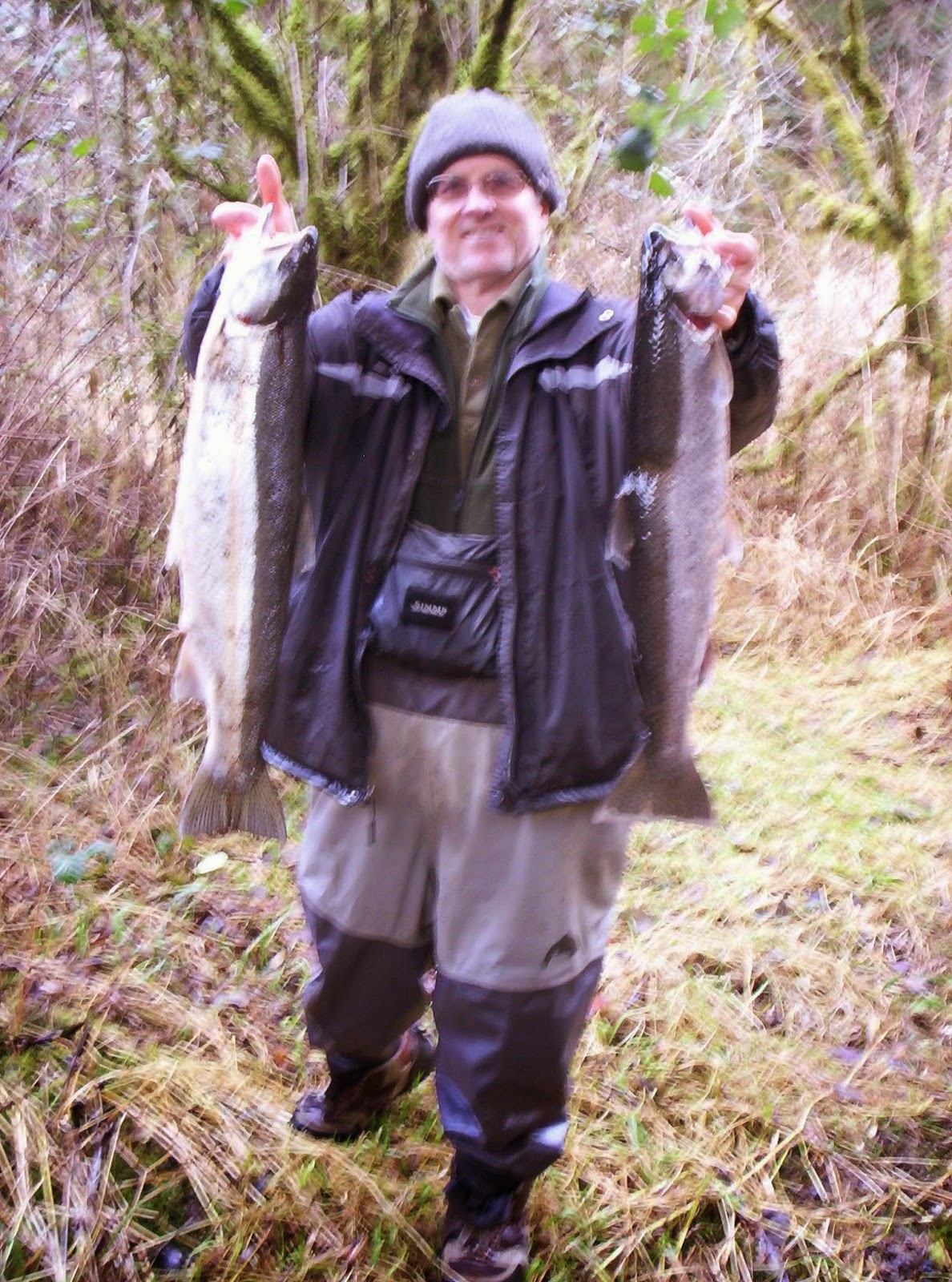
I fished three rivers Monday, and made new friends including this spring chinook.  You'll have to use your imagination for the slow draw on my camera.  Today I caught another 14 pound wild steelhead buck.

Monday, March 30, 2015

Jinxed


Friday I sat fishless on a rock in a rainstorm trying to understand exactly what I did wrong. Then I saw my sweater was on backwards. That explained it.  Saturday I hooked 7, and caught 5 wild steelhead, which were released keeping them in the water without touching them, as you can see.  Needle nose pliers are great for that.  The sweater incident reminds me of how I was unable to catch fish off a new rod until I removed the barcode, and another time I was skunked all day in Eastern Oregon, probably due to unmatched socks.

Monday, March 23, 2015

Slomo Saves His Life

I pass Slomo about 4 times a week on my beach walks. I asked my students who he was, and they said he was a super wealthy brain surgeon who got sick of his life,and decided he only wanted to skate. I thought he was a homeless man with PTSD. My students were right. Check out this great New York Times Video.

Smooth Sailing, Scott

Saturday, March 21, 2015

Finally, the Fishing Movie, A Deliberate Life, is Available, and Lost Salmon

If you love fishing, you may want to watch this trailer of A Deliberate Life.
It begins, "It's easy to lose sight of what's important: family, health, passions, pastimes. To pick your head up and suddenly realize 20 years of your life has simply passed you by. It's easy to get swallowed up and just keep giving more and more of your blood, sweat, and tears in return for less and less happiness."  Watch five anglers find happiness on rivers.  The trailer is good medicine for your soul. I am also happy to report MoonPath Press in Washington will publish my poetry book tentatively titled Lost Salmon due out summer 2016.

Thursday, February 19, 2015

Activist and Fishing Books at 3 Good Books

Thanks to Drew Myron for interviewing me at 3 Good Books regarding my interest in activist poetry. An excellent 5 minute audio of Robert Bly discussing Alden Nowlan's poetry appears at the end.

I saw the fine poet Philip Levine died recently at age 87.  He was quoted as saying, "I'm not a man of action; it finally comes down to that. I'm not so profoundly moral that I can often overcome my fears of prison or torture or exile or poverty. I'm a contemplative person who goes in the corner and writes."  However, he had a bold streak that served him well.  The article by Hillel Italie and Scott Smith linked above noted, "Exhausting factory hours made Levine so determined to write that he showed up in 1953 at the University of Iowa's Writers Workshop even though a planned fellowship had fallen through. He was told he could sign up for one course, but he enrolled in three. One of his teachers, the poet John Berryman, became a mentor."  I've heard "Sometimes vitality will push you through barriers."

At 3 Good Books, I greatly enjoyed the post Henry Hughes on Fishing which listed Thomas McGuane's The Longest Silence, Norman Maclean's A River Runs Through It, and John Engel's Big Water.  I'm glad I  bought Big Water.  There is a blurb inside from my favorite fisher poet Ted Hughes: "It's a kind of poetry about fishing that I've often tried to imagine -- focuses the moment, the target event, and somehow brings to life and holds suspended the whole aura of accompaniment that makes a great memory and a unique happening. [ . . .]"  Henry Hughes wrote, "These poems understand our stewardship and existence through water. [ . . . .] This is an indispensable collection for the poetry-minded angler."

Wednesday, January 28, 2015

Tree Deco, Elk, and Saving Sea Turtles

During the holidays, fishermen decorate trees with bad casts.
Elk, not ants!
Two steelhead I caught at sunrise.
I asked elk where fish were, and, as usual, they knew.

It's great to visit Pacific Northwest coastal wilderness, and I honor it by picking up fishing line to stop birds from getting caught, and foam bait containers killing sea turtles 2000 miles away who mistake them for food.  The message today is even far things are real. The Oceanic Society notes, "Hundreds of thousands of sea turtles, whales, and other marine mammals, and more than 1 million seabirds die each year from ocean pollution and ingestion or entanglement in marine debris. Marine debris is manmade waste that is directly or indirectly disposed of in oceans, rivers, and other waterways."  Help pick it up.

Friday, January 23, 2015

One Arming It in the Coast Range

Washington and Oregon steelheaders wait in icy dark for this, one joyful day at a time.
I hurt my left arm by sleeping on it, which gave steelhead an unfair advantage, but I caught two anyway.  For a month I have been going over boulders and along steep trails exploring, sometimes falling and crashing into brush or river -- but I injured myself in bed.  It reminds me of hearing about astronaut John H. Glenn, Jr. who orbited Earth in Friendship 7 in 1962, and in 1964 slipped in his bathroom and hit his head on his bathtub, injuring his inner ear.  It could happen to anyone.

Maybe my injured arm is karma for accidentally hooking a steelhead in the arm.  As I said before, the river has a life of her own. As Tom Robbins said in my post below, "Joy in Spite of Everything."

Tuesday, January 20, 2015

Calling in to Work Well

"My personal motto has always been: Joy in spite of everything. Not just [mindless] joy, but joy in spite of everything. Recognizing the inequities and the suffering and the corruption and all that but refusing to let it rain on my parade. And I advocate this to other people." ~ Tom Robbins

I love teaching creative writing (even to you, Hieronomous), and lit. but composition class grading has become too exhausting. Hence, the Robbins quote above.  Soon, I will be trading these:
for these:
Mountains of papers to grade.

But not for long.  Reduced load/early retirement will happen in a few years, or before.

I could start a "Send Scott Fishing Fund" but I know deep in my barbed heart Amnesty International  and Eugene Bell Foundation are better causes.

"Stop whining, you lazy professor," some have said, and will say.  Someday, I hope to call in to work well. It reminds me of an interview, "Tom Robbins: Joy in Spite of Everything," I assigned to students 20 years ago to get some creativity out of them. Bill Strickland, the author, gave written permission for free while George Orwell's estate wanted to charge each term to use "Politics and the English Language." Michael Hiltzik at the Los Angeles Times now links it for free, ranking it as Orwell's "No. 1" essay.  Ray Bradbury wrote me a personal letter, also giving written permission to use his famous, and ecologically wise, short story, "A Sound of Thunder," without copyright restrictions. In a "Meet the Writer" box at the end of the story, Bradbury "claims to remember everything -- every book he's read, every movie he's seen, all the events of his life back to and including his birth, [ . . . .] his fantasy stories are often warnings against blind faith in science [ . . . . ]" Bradbury's success is a good reason for want-to-be-writers to "Turn on, tune in, drop out" as noted by Timothy Leary, though I would advocate mountains and rivers instead of LSD, or modern drugs like NBC, ABC, CBS, etc.  Allen Ginsberg once told me and about 14 other grad students at Eastern Washington University to avoid drugs and anything that can weaken one's potential as a writer.  William Stafford said the best way to write 40 years is to avoid alcohol.

Anyway, here are memorable excerpts from the Strickland interview with Robbins: “One day, I had gone to the bank, and was hurrying back to the Seattle Times, back to my job. I was walking very fast and very intently, with my coattails flapping and my tie swinging over my shoulder. I was a harried young man, on the way up. And in the distance, I saw a figure approaching — a man with red hair, bewhiskered not like he cultivated a beard, but more like he’d been drunk for four days and hadn’t shaved. Wearing a World War II overcoat, the hem dragging the sidewalk."

“And he was singing, walking up the sidewalk singing. When he got really close to me — he was watching me all the way because I was watching him — he looked at me in the face and laughed, burst out in derisive laughter. It was as if he had seen through me, and registered all my areas of discontent, and then laughed at it all. He might have been a mesquilito, a peyote god, a Pan-like figure. I just call him the red-headed wino.”

“On Monday, I called into work well. I said, ‘I’ve been sick for a long time, but I’m well today so I can’t make it in.’ I went to New York.” 

Friday, January 16, 2015

Steelhead and Gremlin Cities


Gremlin cites.  They are good at hiding.
At night, while I'm dreaming, rain brings fresh steelhead in from the Pacific.

Tuesday, January 13, 2015

The Case of Mad Steelhead and Slides

Hoffman Center in Manzanita, Oregon
I caught these two steelhead by 8 a.m. yesterday so I looked for the so-called "Slide Area."  I wore surfer shorts because I wanted to show off my 102-year-old abs on a water slide.  I looked around the mountain for the "slide" but all I saw were rocks in the road.  Go figure.

On the brighter side, I caught another steelie this morning before my presentation at Hoffman Center.  The people at Hoffman were creative, welcoming, and authentic which is why I feel at home in Oregon.  For those who love words, and sharing words, you may want to visit one of their Tuesday Writing Lounges from 10:30 a.m. to 1 p.m.  The nearby beach walk and trails on Neahkahnie Mountain will rock your soul.  Click on Hoffman Center Calendar for updates and other events.

Saturday, January 10, 2015

"All's Well That Ends Well, Mostly"

This is the dreaded wooka hooka wae wombat track.  These guys crawl from brush to steal your steelhead.  I'm working on a wooka hooka wae repellent to go with my bigfoot repellent which is guaranteed for life or your money back.
My elaborate mathematical tackle organization will immediately remind students of my desk at the college.
Is a steelhead under the old oak tree?
Is a steelhead under the waterfall?
Some say fishing with a broken rod is more sportsmanlike.  I don't.
"All's Well That Ends Well, Mostly"
Old One
The Old Ones at Coastal Creek

are just stumps of their former selves.
Once, 200 feet tall,
now round red-fleshed nurseries 
for new green seedlings
which haven't yet seen Columbus Day Storms
rolling in from the Pacific
and spawning giants that follow,
silver bright then copper
then black until ivory bones fill
deep shady pools to fertilize new roots.

Sometimes while fishing
you notice an Old One above your cast
or on the trail over your shoulder.
When you get anywhere near one
if there is any sin in your life
you know it.

(Thanks to The Oregonian and Sitka Center for Art and Ecology for publishing this poem, and to Write Around Portland for putting it on their office door when I taught there.)

Tuesday, January 6, 2015

New Owner: No Trespassing Except for Blondes

"New Owner: No Trespassing Except for Blondes" was the sign over one of my best holes on seldom-fished Secret River, and it was enough to quake my Reeboks.  There must be a way to deal with this, I thought. And there was. 


I drove to Goodwill, and bought a blonde wig.  I used balloons for breasts, and drove back.

On the way, one of the balloons lost air so I had uneven breasts.  I hadn't shaved in four days which probably didn't help my case.  On the second cast, I caught a beautiful hatchery buck steelhead about 16 pounds pictured above.  A few casts later, I caught his little brother.  As I was carrying them up the trail, an old gray codger appeared on a bluff.  "Well, you ain't the prettiest blonde I seen" he scoffed. "But rules is rules."

"Come here and give Hilda a kiss," I cackled.

"No thanks," he said, then walked up to his white house with green trim, and slammed the door -- hard.

 The lengths some guys will go to catch a steelhead.

With two fish in the cooler, I drove to the Oregon coast to attend the Writing Lounge at Hoffman Center in Manzanita.  Great people, and great sharing.  I was invited to offer a writing prompt next week, Jan. 13, 10:30 a.m. to 1 p.m. during their Writing Lounge. There is a $5 suggested donation which helps the Hoffman Center and their literary/art journal North Coast Squid. Maybe I'll see you there.


Monday, December 29, 2014

Healing Time

Three days after grading a mountain of papers, I was back in Oregon.  The World Lit. and Creative Nonfiction ones were amazing, amazing, amazing, but still exhausting since I'm 102 years old.  Buck Steelhead in old growth says,"Let the healing begin."

In Old Growth Forest

I don't want to see van Gogh, Renoir, Monet,
read Rilke or Kafka, hear Mozart, or anything,
no matter how artful, from a human mind.

Instead, I focus my yarn fly along giant logs,
undercut cliffs, ready for the instant I feel
winter's electric strike.

In hanging moss, creek music, sunlight
through ancient fir and spruce,
beside elk, raccoon, heron tracks in mud

men harvest blazing silver and pink steelhead
fresh from God's ocean.
At night I smile the smile well-rested and joyful

like I slept in a land of Paradise dreams
a thousand years.

Sunday, December 7, 2014

Ain't Nothin' Like Summer in Late November

Iner, I think I found some fish (whisper).
A few springs ago, I helped an old guy who ran out of weights so he gave me his best November spot in eastern Oregon.  I caught 4 steelhead and lost one.  On the way home, I found more coho under a rainbow sky.

Tuesday, November 11, 2014

Remembering Ross on Veterans Day

A half-blind Korean War vet, Ross, took me trolling on the Willamette Channel to catch my first salmon there.  He was a platoon leader, and I later found out one of two men in his platoon to survive combat.  Ross never mentioned war, that he had been in combat most of the time, fighting at Heartbreak Ridge, or that he carried a wounded friend named Tex many miles to safety.  Instead, we spent days in comfortable silence, eyes on rod tips, anticipating strikes of early spring chinook.

It didn't matter if we fished in rain, mist, or sun, Ross always had an internal smile that made people want to be around him.  The day I caught the above fish, I knew something extremely important had happened in my life.  I didn't know that among Columbia River tribes, catching one's first salmon was a rite of passage.  I nailed the salmon’s head to a Douglas fir in my backyard.

Ross taught me to kill fish quickly and cleanly without anger, in a way I would desire to be killed if I were the fish.

Tuesday, October 28, 2014

Woola Woola Scores Again

An October rainbow road means good luck fishin', and it was.
The missing piece of my boot appears in the next photo.
Silvers left in the river eventually turn to colors of leaves.
I keep trying to get to the Portland, Oregon, Airport, but the fish say no.  The rivers on the way are too tempting, even if I smell like bait on the plane.

Man, I sure do like those "Slow Release Scent Leads" by Woolawoola-hummahumma-ki Tackle Company, sort of a Slinky-like weight that is advertised as "The next best thing to chumming!"  The shrimp/anise seems to work best, which is like a lemon/lime snowcone to a human on a hot summer day.  If you try one, put a hook in the lead in case fish bite it. 

Saturday, October 25, 2014

Tillamook, Greenland

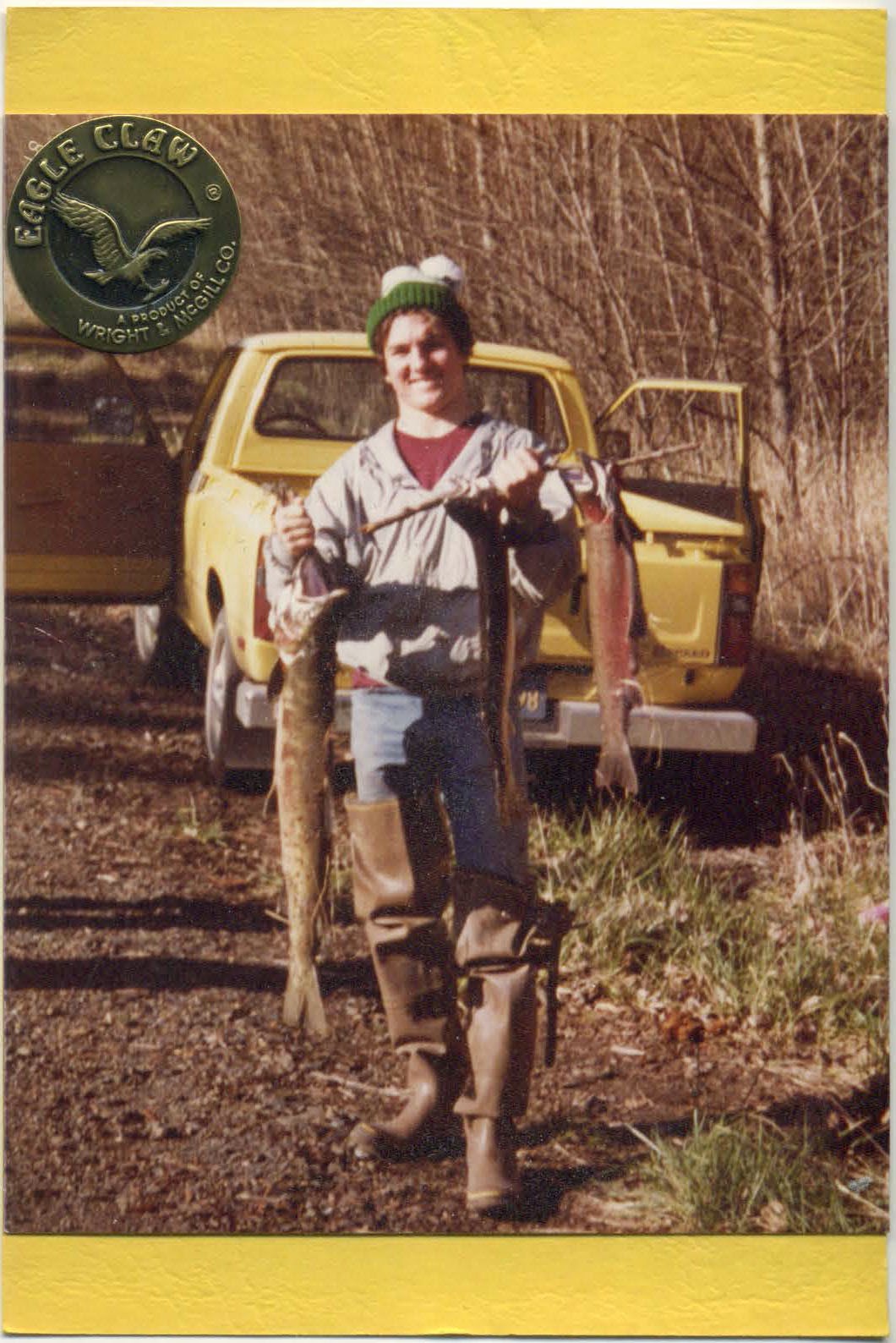
3 Clackamas steelies I caught in 1979.
A coastal fall chinook I caught yesterday. Where did I leave that hat?
Living vs Existing
Too dark to keep but pretty fall colors.
Speaking of the Clackamas River, here are three I caught in 1979 before the crowds. 

Suz netted my fall chinook yesterday.  The only thing better than a mermaid is one who knows how to net a salmon.  She lost a bright coho but caught the fisherman.

I was so stressed after the move from Whidbey back to Portland, Oregon, I had to go fishing. Sometimes fishing stresses me out then I have to go fishing to relieve the stress.  Things like wrongly placed blackberry vines mean holes in face, or worse, in waders.  Wrongly placed boulders mean a fisherman in the river amongst the fish.  ODFW should consider their placements of these things.

On the river, I was thinking all these fish photos and poem notices have been sort of vying for attention, and certainly there is a land more satisfying than vying for attention.  Just being on an Oregon coastal river alone or with a mermaid is pure magic. 

However, when I'm not fishing, I still want to write and sell poetry books.  My newest one, Tillamook, Greenland made it past the query stage to the 40-page proposal stage at Portland State University's Ooligan Press which publishes books about "cultural and natural diversity of the Pacific Northwest," a perfect fit for this one.  I know from my days fly fishing that sometimes the presentation can be right but there are still no takers.  The river has a life of her own.

Sunday, October 12, 2014

Remembering the Clackamas

My Winter Steelhead Ritual above Carver Boat Launch donated to White Wolf Sanctuary in Tidewater, OR.
Seeing Rivers of a Lost Coast made me reflect on my home river, the Clackamas, named after an Indian tribe in Oregon which researchers note had been in the area about 10,000 years.  It had memorable fishers, memorable fish, and a rich history of spring, summer, fall, and winter water-magic.  I once lived in Carver,  and while growing up in nearby towns that river and her fish were all I could think of many gradeschool and highschool days.

I made the above clay art with bones of a steelhead I caught and ate from the Clackamas.

The Clackamas was Rudyard Kipling's favorite river.  The Noble Prize-winning author caught his first salmon here though some say it was a steelhead.  Regardless, he wrote, "“I was up the bank lying full length on the sweet-scented grass and gasping in company with my first salmon caught, played and landed on an eight-ounce rod. My hands were cut and bleeding, I was dripping with sweat, spangled like a harlequin with scales, water from my waist down, nose peeled by the sun, but utterly, supremely, and consummately happy.”  I know what he meant.  I imagine 10 seconds before my death, I will be thinking about this river instead of all the volumes of chicken-scratch ink marks on pages meant to transfer others' ideas to my restless want-to-be-fishing mind.

Most composition students, creative writing students, and literature students would have benefited from floating part of this 83-mile river with me, and fishing for winter steelhead, spring chinook, summer steelhead, and coho.  Like Kipling, they would have real-world experiences to write about, and to relate to famous works of literature.  Looking across years of composition students, some were gifted or excited to write, but far too many eyes and hearts were so glazed that if they were pastries the blockage would be the size of Texas donuts.There is probably no better medicine for this than a glacier-fed wild river. 

The Clackamas, like many damaged rivers in Northern California, had her heyday before troubles.  Salmon and Steelhead Runs and Related Events of the Clackamas River Basin -- a Historical Perspective notes, "One avid fisherman, Charles Mack, clearly recalls a particular fishing season in the late 1930s when he caught 68 spring chinook, weighing an average of 19 pounds each."  The document also notes, "Livingston Stone [ . . . wrote in] 1877 that 'probably no tributary of the Columbia has abounded so profusely with salmon in past years as this river (the Clackamas)' (US Commission of Fish and Fisheries 1877)."  Unfortunately, “Records show that upstream salmon migration was restricted as early as 1868 after a dam was built on the Clackamas River near Gladstone. This dam, or another near it, continued to impede passage until a fish ladder was provided in 1895.” and  “In 1917 the ladder at Cazadero Dam washed out and was not reconstructed until 1939.”  I guess there were so many salmon in those days that, like in northern California, the supply seemed inexhaustible.

I hiked the headwaters near Olallie Butte, about 10 miles north of Mt. Jefferson, all the way to where the Clackamas enters the Willamette near Oregon City, imagining ripe old old days before white settlers, or scouting for fish to catch in modern times. 

In my book River Walker, I wrote about a childhood river experience that has stayed with me:

Clackamas River Mermaids

At age 7 when I saw a man and woman making love
waist-deep in the Clackamas River above Barton Park
I thought mermaids were swimming upriver
like they did every thousand years or so
to spawn with lucky fishermen
and die in pine grottos
of their Pacific ancestors.

It was 1970 and, according to many sources, about 35,000 anti-Vietnam War music lovers were gathered for seven days of outdoor concerts upriver at McIver State Park near Estacada, with snow capped Mt. Hood in the background and August's bright sun reflecting off pure crystal waters.  

However, quiet moments on the Clackamas are what I remember best.  The finest spoon fisherman I knew, Ken Bogle, taught me to fish a Krocodile, and showed the importance of pausing it at the end of a swing to entice a strike.  Clayton Timothy taught how to drift fish with just enough lead to keep my corky near the bottom, but not enough to slow it much. Later, I taught 15-year-old Jake to spinner fish.  I caught my largest winter steelhead here, an 18 and a half pound buck that showed the silver-sided reward of patience and deep listening.

Saturday, October 11, 2014

Rivers of a Lost Coast

Rivers of a Lost Coast Trailer

I watched Rivers of a Lost Coast tonight.  It was about the legendary salmon and steelhead runs in northern California, and rare men who sacrificed "the narcotic of civilzation" to be with them right to the bitter end, even, in the case of Bill Schaadt, giving one's entire daily life to the pursuit.  It was prophetic regarding how fast these magical fish runs can be lost due to logging, drought, water diversion, dams, overfishing, public apathy, and poor planning.

I have fished from the Rogue in southern Oregon to the Tanana near Fairbanks, Alaska, and spent 10 years as a commercial fisherman, and eight years as a charter captain.  I am glad anyone who has dedication and time can still find river moments like those on the Eel and Smith in the 1940s.

There is nothing on Earth that comes close to the brilliance of these fish and the natural joyful spirits of men who served as mentors and innovators.  This film was a reminder of the concept one has to give back to the river, and to fight for rivers one loves.  That can be as big as supporting Save Our Wild Salmon, or as small as carrying a trash bag to the river to pick up mono, beer cans, and discarded gear.  It can also mean taking time off from fishing to educate young anglers how to toss spoons, spinners, jigs, or floats, and show why it is more satisfying to hook an aggressive fish than to snag one in the back.

Some men claim there is no way to stop "progress" so these fish must be lost.  Whenever I hear this, I recall the Hopi Tribe in Arizona, which as I wrote at The Raven Chronicles,  "in 1995 [said] 'No' to a casino for reported 'political, cultural and religious reasons,' and repeat[ed] 'No' to slot machines in 2004." The point is, we have clear choices.

Tuesday, September 30, 2014

Fallchinookville

Here is a big guy I caught on an Oregon coastal river.  When I was a kid fishing in the same spot, a giant one, maybe 60 or 70 pounds, knocked me on my butt as I guided him to shore, then charged with his hooked toothy jaw, swerving at the last instant as his submarine airborne olive-speckled back sank into green invisibility.  The line broke and neurons fired.  I was living.

Last year, Toyon, at Humboldt State University, published a poem about another big salmon I lost:

Cliff Salmon

The monster Chinook bit my lure, my foot slipped,
and I crashed 14 feet into the water with a sore butt cushioned by stones.
Stuart jabbed me with a net to save my life but I told him to get the fish.

In that moment I was a water version of Sam McGee standing heart-deep,
bloody arms and legs, happily watching the olive-spotted slab
of ocean-bright silver run and roll and head shake and leap.

Five freight train runs and still strong enough to make the reel sing.
Five freight train runs and still strong enough to break the surface
of that other world.

Our adrenaline surged around boulders into slack water,
him eyeing the crazy fisherman who wouldn’t let go,
me eyeing his ancient prize of 10,000 years of wild red flesh,

brought together by hard rain down the mountain,
he, eventually tearing free of the hook, and I, outside the flames of time
for only as long as we fought.